




Engineering Protein-Based Hybrid Composites and Self-assembled Biomaterials for Nanomedicine and Bioelectronics
Abstract:
Nature provides exquisite strategies for constructing functional materials through self-assembly, inspiring the design of next-generation nanostructures for biomedical and technological applications. In our group, we exploit engineered repeat proteins as robust and versatile scaffolds to generate ordered biomaterials and hybrid nanostructures with defined architectures and functions. Their high stability and programmable modularity allow us to encode controllable supramolecular assembly properties and to introduce tailored functionalities, including specific binding capabilities and metal-coordination motifs.
We have explored strategies that rely on rational design of protein self-assembly and the re-engineering interactions within innate protein-protein contacts in crystalline lattices. On one hand, we demonstrate the potential to generate diverse crystalline protein frameworks by tuning the innate metal coordination preferences, guiding protein assembly for engineered consensus tetratricopeptide repeat (CTPR) proteins.[1] On the other hand, we have developed strategies to create ordered protein-based biomaterials by re-engineering protein-protein interactions that maintain the crystalline lattices, and by interfacing proteins with other self-assembly elements such as amyloid-derived peptides. Through these methods, we direct the assembly of proteins into structured thin films, 2D monolayers, or 3D tubular architectures.[2]
Additionally, we have developed protein-metal hybrids by engineering metal-binding residues, and the subsequent formation of tailored nanomaterials stabilized by proteins with unique luminescent, magnetic, or catalytic properties. Generally, the fusion of two distinct materials exploits the best properties of each, however, in protein-nanomaterial hybrids, the fusion takes on a new dimension as new properties arise.
Overall, our work illustrates how rational protein engineering can drive the creation of self-assembled hybrid materials with programmable structure and function. We present selected applications of these materials in the fields of bioelectronics,[2,3,4,5] and biomedicine.[6,7]
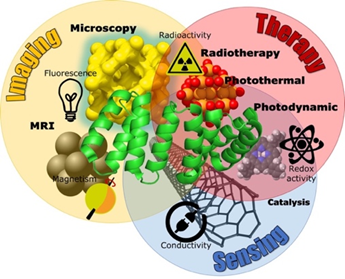
Scheme of engineered protein-based hybrids and functional biomaterials.
References:
[1] Liutkus, A…., Cortajarena, A,L., Protein Science (2024), 33: e4971.
[2] Perez-Chririnos, L…., Cortajarena, A,L, ACS Nano. (2015) 17: 16500–16516.
[3] Dominguez‐Alfaro, A…., Cortajarena, A,L., Small (2022): 2307536.
[4] Mejias, SH…., Cortajarena, A,L, Nanoscale (2021) 13: 6772-6779.
[5] Cortés-Ossa, JD….. Cortajarena, A,L, Adv. Materials (2025), e08838.<ì>
[6] Aires, A. .. Cortajarena, AL, Chem Science (2021), 12: 2480-2487.
[7] Uribe, KB … Cortajarena, AL, Acc. Chem. Res. (2021), 54: 4166-4177
Short bio:
Prof. Aitziber Cortajarena earned her Ph.D. in Biochemistry from the Universidad del País Vasco in 2002. Then, she worked on protein design in the group of Dr. Lynne Regan at Yale University, USA, as a Postdoctoral Fellow and Associate Research Scientist. She joined IMDEA Nanociencia in 2010 and started her independent research in nanobiotechnology. In 2016, she joined CIC biomaGUNE as Ikerbasque Research Professor. Currently, she leads the Biomolecular Nanotechnology group and is Scientific Director at CIC biomaGUNE since 2022.
Her research focuses on protein engineering toward the generation of functional nanostructures and bioinspired materials for applications in biotechnology and biomedicine.
This seminar is hosted by Sara Hernández Mejías (This email address is being protected from spambots. You need JavaScript enabled to view it.)
To get an assistance certificate for this seminar, register now and sign the assistance form during the seminar: https://docs.google.com/forms/d/e/1FAIpQLSdcjReHGWP82dto4d774P8siErEnP4iiJTVDS7_fxLJzPhpCg/viewform?usp=publish-editor